How the Kyushu Basho Actually Works
Divisions, ranks, how a bout is won and the 15-day format behind the Kyushu Basho, plus the Fukuoka story that ended last year's tournament.
Fifteen days, one ring, and a format that hasn’t changed in any way that matters. Each top-division wrestler fights once a day; the lower divisions fight seven times across the tournament; the best record wins.
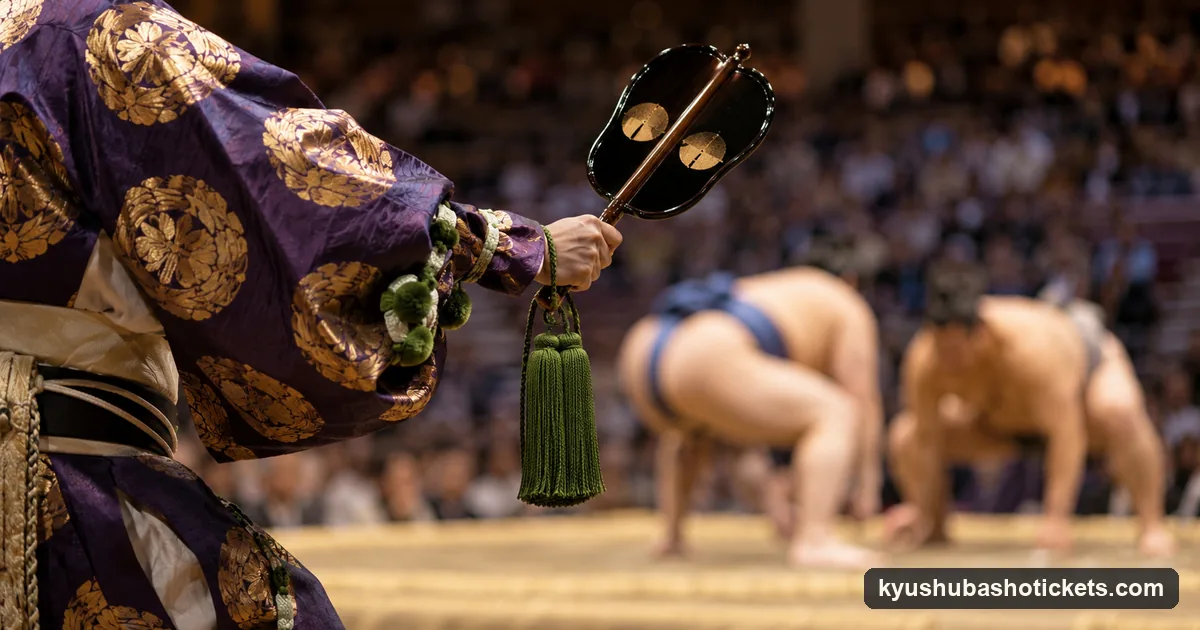
If the rules are new to you, Yummy Guide’s tour pairs a chair-seat ticket with an English-speaking guide who runs through the history, rankings and rituals before you go in. It’s from $634 on the booking platform when we checked, with no reviews yet, useful if you’d rather have that briefing in person than read it cold here.
The divisions, top to bottom
Makuuchi, the top division, holds up to 42 wrestlers across five ranks: yokozuna, ozeki, sekiwake, komusubi and maegashira. Below it sits juryo, where a wrestler becomes a sekitori — entitled to the ceremonial apron and the ginkgo-leaf topknot, and generally reckoned a professional in full. Below juryo come makushita, sandanme, jonidan and jonokuchi, where most of the roughly 700 active wrestlers actually compete.
Winning a bout
A wrestler loses the moment any part of him touches the ground inside the ring, even a fingertip or the tip of his topknot, or the instant one foot or heel crosses the straw bale marking its edge. Punches, hair-pulling, eye-gouging, choking and kicks to the stomach or chest are all barred, and there are no weight classes: the association recognizes 82 named winning techniques, from a straightforward shove to a wide variety of throws and trips.
Ranks, as of September
Until the new banzuke appears on 26 October 2026, every name here reflects the September list: yokozuna Onosato and Hoshoryu, and ozeki Kirishima, Kotozakura and Aonishiki. Recheck those names after the 26th. Even a yokozuna can withdraw mid-tournament for injury, so treat any promise of seeing a particular star as “normally,” not a guarantee.
Winning the tournament
The wrestler with the best record over the 15 days receives the Emperor’s Cup on the final day, with a playoff if two or more are tied. Three further prizes, for outstanding performance, fighting spirit and technique, go to wrestlers ranked sekiwake and below who won at least eight of their fifteen bouts.
Last November, in this same hall, the newly promoted sekiwake Aonishiki beat Yokozuna Hoshoryu in a playoff after both finished 12-3, taking his first title and becoming the first champion from Ukraine. He reached ozeki faster than anyone under the sport’s current six-tournament system. He’s back in Fukuoka this year carrying that rank.
Check dates for the guided seat
What you’ll actually see happen
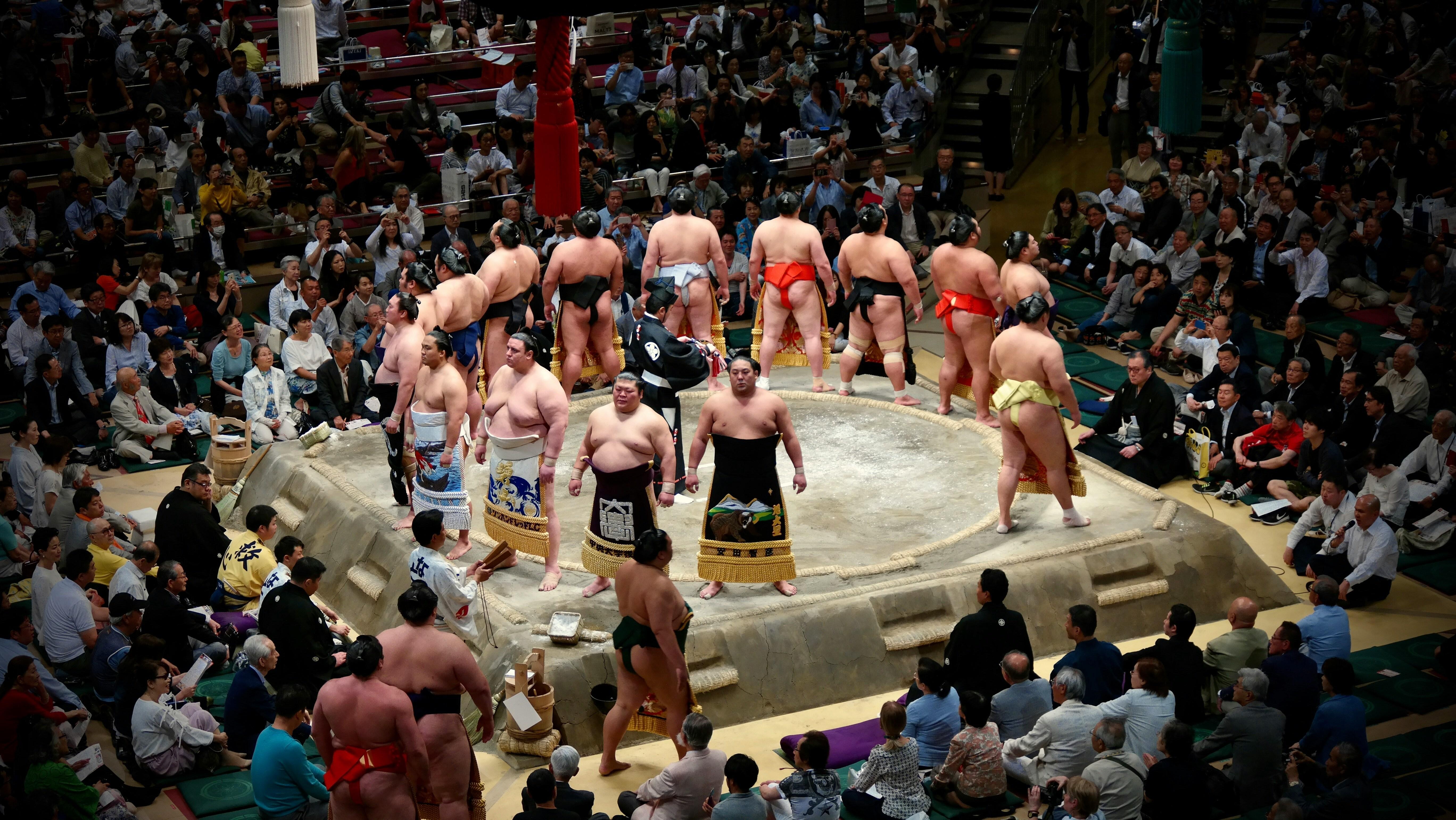
The ring-entering ceremonies punctuate the afternoon: juryo wrestlers enter in their embroidered aprons around 2:15 p.m., the makuuchi division around 3:40 p.m., and the yokozuna around 3:55 p.m., flanked by a sword-bearer and a dew-sweeper as the crowd calls out “yoisho!” with each stamp. Before many top-division bouts, you’ll also see a ring of rectangular banners carried once around the dohyo, one for each sponsor backing that particular match. Each banner costs its sponsor ¥70,000; ¥60,000 of that goes to the bout’s winner, who also collects ¥30,000 in cash, handed over in the ring itself once the result is called.
Following along without Japanese
The bout sheet handed to every spectator on the way in is printed in Japanese, so don’t expect an English programme at your seat. NHK World’s “Grand Sumo Live” broadcasts days 1, 8, 14 and 15 live with English commentary, and the association’s own “Grand Sumo” phone app carries English wrestler profiles, records and daily highlight video year-round, alongside an English YouTube channel for the same clips. None of that replaces being there, but it fills in names and context a guide might otherwise be explaining out loud.
One more thing the rules ask of you directly: however dramatic the result, don’t throw your cushion into the ring. It happens anyway when a yokozuna loses unexpectedly, but the association’s own spectator rules ask fans not to, citing the real risk of hurting someone below.
For when each of these moments happens on the calendar, see Kyushu Basho dates, and the seating chart covers where you’ll be sitting to watch it. Every listing on this site is compared on the homepage.
Sources: the Japan Sumo Association’s English primer, its kensho and timetable pages, and national press coverage of the September 2026 and November 2025 tournaments. Product details from our own October 2026 data check.
Book the Chair-Seat Tour With a Guide
Yummy Guide's chair-seat ticket pairs a tournament seat with an English-speaking guide, who briefs you before entry and helps with admission. It has no reviews yet. Free cancellation up to 24 hours before — pick your day once your travel dates are set.
Check Availability & Book